How long does it take to walk up Fushimi Inari?
A realistic answer to how long the Fushimi Inari walk takes, what the climb involves, and how the shrine's own figures describe the mountain, plus how it fits a Kyoto and Nara plan.
How long does it take to walk up Fushimi Inari?
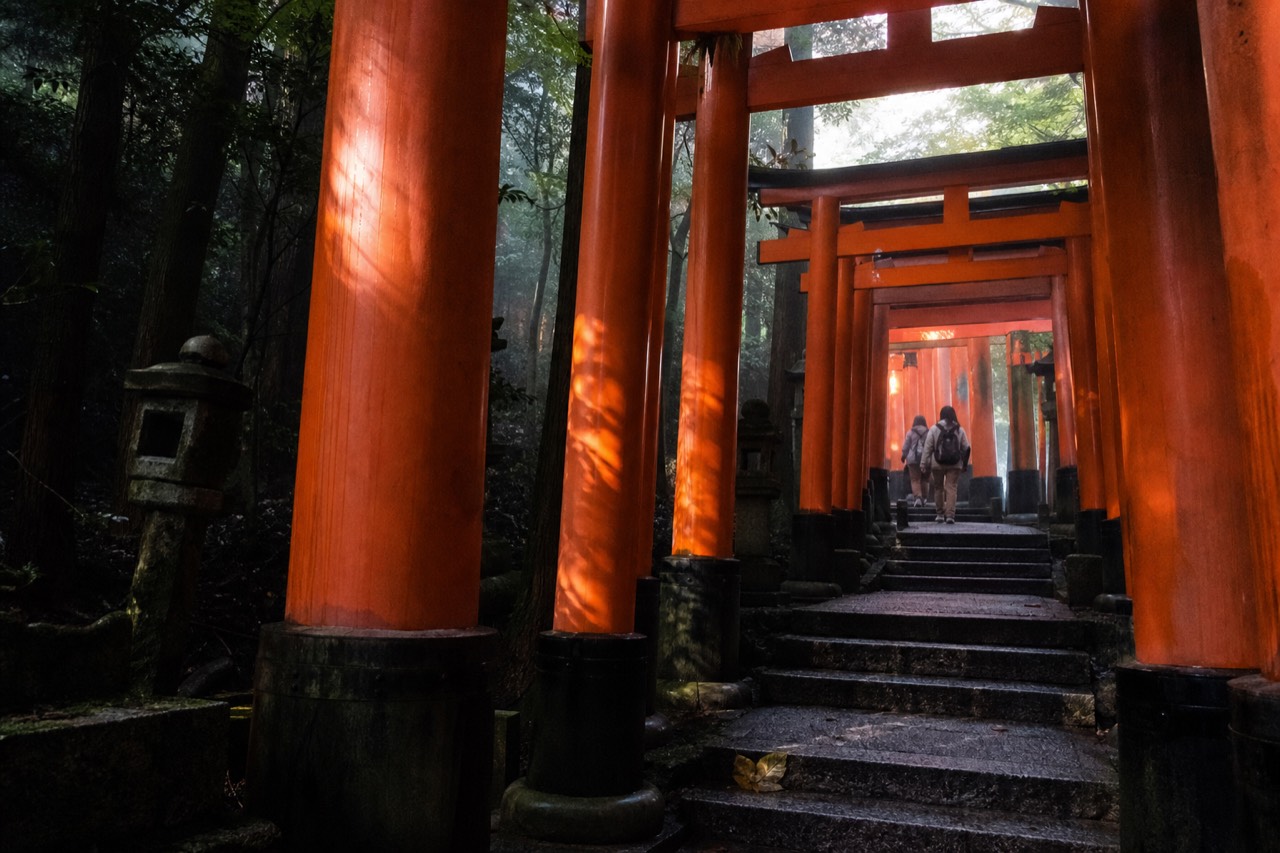
The full round trip to the summit of Mount Inari takes about two to three hours at a steady pace, over stone steps and forest paths that climb the entire mountain. Most of the famous vermilion tunnel sits near the base, so a visitor who only wants the classic gate scenery can turn back well before the summit and still see the best-known section in a fraction of that time.
One thing to clear up first, because this site is built around a single bookable product: Fushimi Inari is not a stop on the Kyoto and Nara day tour this site covers. That coach tour visits Nijo Castle, Kinkaku-ji, the Kyoto Imperial Palace, lunch on some options, Kasuga Taisha, and Todai-ji with Nara Park. Fushimi Inari sits on the opposite side of Kyoto from Nara, and no version of the tour goes there. Everything in this article is for people planning the shrine under their own steam, which is entirely doable.
The two-to-three-hour figure is a consensus estimate rather than an official shrine statistic, so treat it as a planning range, not a timetable. What is official, and surprisingly generous, is the shrine's own description of the precinct. Fushimi Inari Taisha's FAQ states that the grounds cover about 260,000 tsubo, roughly 870,000 square metres, which the shrine compares to about 22 Koshien Stadiums. Most of that is the mountain itself: Mount Inari is the southernmost of Kyoto's Higashiyama 36 peaks, and the walking course threads up, around and across it.
That scale explains the time. The walk is not a single ascent and descent but a circuit of shrines, gate tunnels and viewing points spread over a whole hillside, and the summit proper, with its cluster of small shrines and rocks tied with paper wishes, sits above the point where most casual visitors give up and turn around.
Here is the verified picture of what the walk involves, at a glance:
| What | The figure | Source status |
|---|---|---|
| Round trip to the summit | about 2 to 3 hours | live-search consensus, not a shrine figure |
| Torii gates | about 10,000 of all sizes along the mountain paths | the shrine's own FAQ |
| Precinct size | about 870,000 sq m, roughly 22 Koshien Stadiums | the shrine's own FAQ |
| Admission | free | no admission charge published |
| Closing time | the shrine sets no closing time for the paths | the shrine publishes only desk hours |
| Standing | head shrine of roughly 30,000 Inari shrines nationwide | the shrine's own FAQ |
For readers weighing a guided day against a self-guided one, these three options cover the same six stops with different departure points and lunch arrangements:
What does the climb to the summit involve?
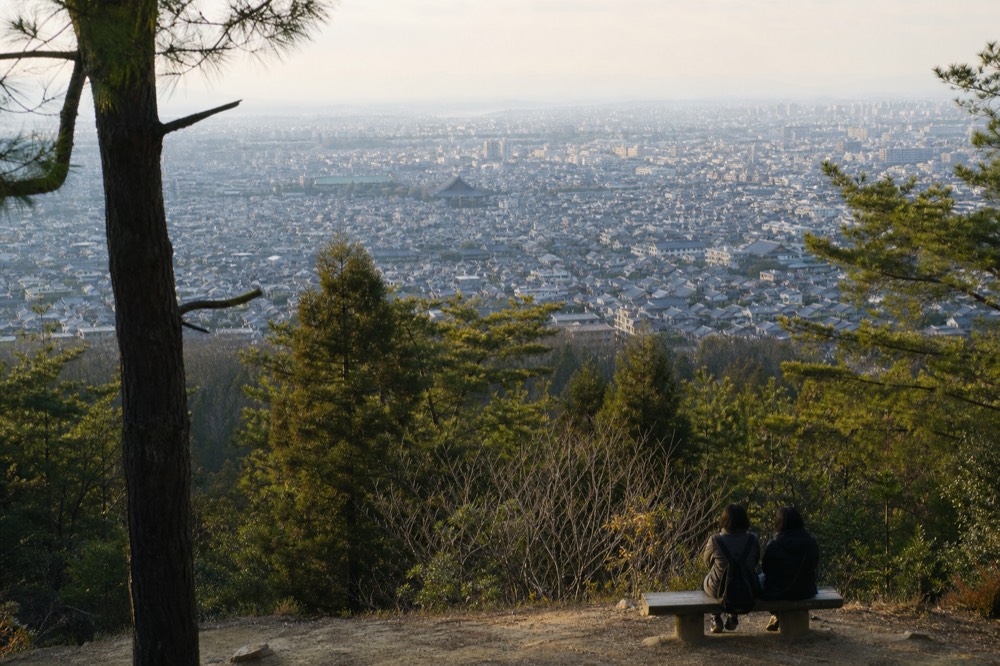
The route is a continuous mountain circuit: a gentle start through the main shrine grounds and the famous tunnel, then a long stretch of stone steps through cedar forest, a mid-mountain viewpoint at Yotsutsuji, and a final quieter push to the summit shrines before the loop descends the far side. Footing is generally good but uneven in places, and the climb is sustained enough that ordinary shoes and a little water matter more than any special equipment.
The character of the walk changes three times, and knowing that helps you decide how far to go. The first section, from the main hall through the Senbon Torii, is the postcard: dense, closely spaced gates, flat to gently rising ground, and the heaviest crowds of the whole mountain. This is where the overwhelming majority of photographs are taken, and where a visitor with limited time gets the greatest return per minute.
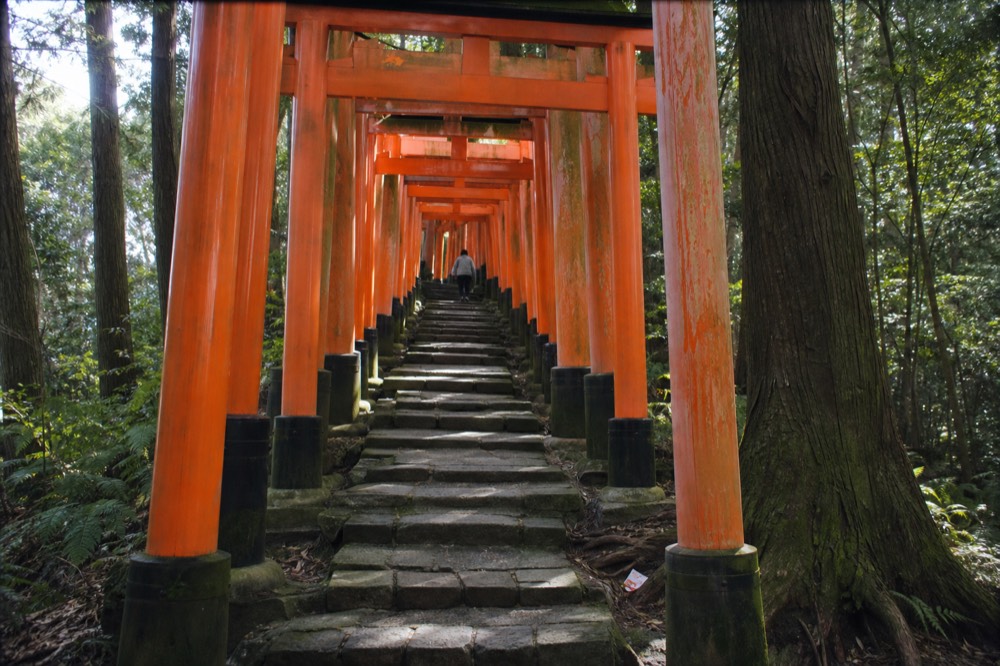
Past the tunnel the mountain takes over. The path becomes stepped forest trail, the gates thin out to occasional singles and small clusters, and the crowd drops sharply with every flight of stairs. Somewhere in this stretch the sound of the city fades and the walk stops being a sightseeing stop and becomes a proper hike, which is exactly why many locals come here before work.
The upper mountain is the quietest part. Smaller sub-shrines sit in clearings, stone fox statues crop up along the moss, and the summit area, marked by a cluster of tied rocks and modest halls, is far plainer than first-time visitors expect. The descent loops down the far side of the mountain and returns you to the main grounds along a different approach, so even the full circuit rarely repeats itself.
Why are there so many gates in the first place? The shrine's own explanation is that donating a torii as thanks for a prayer "passing" spread from the Edo period onward, which is why the count keeps growing and why the gates range from pocket-sized to taller than a bus.
How many torii gates do you pass on the way up?
The shrine's own answer is about 10,000 torii of all sizes standing along the mountain paths, a figure that covers the entire sacred mountain rather than just the famous tunnel near the base. The count is explicitly approximate, the shrine prints the word "about", and no exact number exists anywhere official, so treat any precise figure a blog or video quotes as invented rather than sourced. The gates you actually pass depend entirely on how far you climb, because they thin out steadily above the tunnel.
The distinction matters because the two numbers get conflated constantly. The Senbon Torii, the two parallel dense tunnels of gates behind the main hall, is the section everyone photographs, and it holds only a fraction of the mountain's total. The rest are scattered along the summit circuit: single gates at sub-shrine entrances, short rows on the forest stairs, and small votive gates clustered around the peak. A visitor who walks the full loop passes gates almost continuously; the tunnel is only a fraction of the roughly 10,000 gates the shrine counts across the whole mountain.
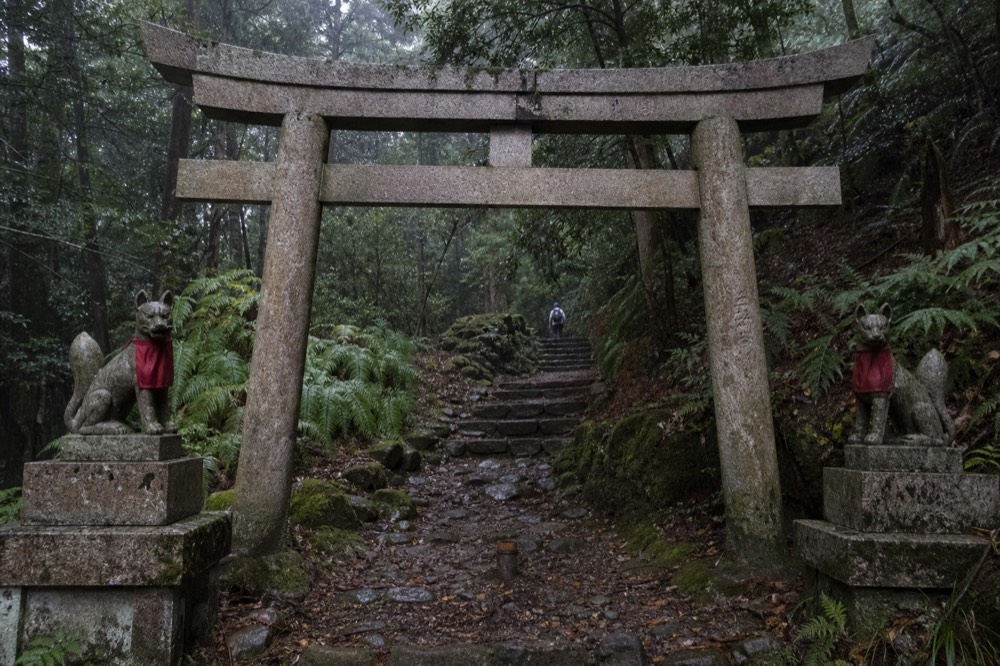
The gates' density is also the mountain's crowd map. Where the torii crowd together, so do the people; where they thin to one every few hundred metres, the trail empties out fast. If your answer to the how-long question is "as long as it takes to get the photo", the dense lower section is your destination. If your answer is "as long as the walk deserves", keep climbing, because the upper gates, older and quieter and half-swallowed by cedar shade, are arguably the better ones. The deeper background on the count and its history is in our dedicated piece on how many torii gates Fushimi Inari has.
For anyone comparing the shrine against the rest of a Kansai itinerary, this is also the moment to be honest about the day tour this site covers. The tour's price covers a licensed English-speaking guide, the coach between cities, and the admissions at the stops it visits, so what you pay is what the day costs, with no temple-ticket surprises at each gate. Fushimi Inari, being free to enter and not on the route, sits outside that equation entirely.
When should you do the walk, and what should you bring?
Do it early or late in the day, because the shrine sets no closing time for the paths and the lower gates are the most crowded section of any attraction in Kyoto; bring water, comfortable shoes with grip, and cash for the small shrines and stalls on the mountain. The shrine itself publishes only desk hours for prayers, amulets and goshuin stamps, not opening hours for the precinct, so the walk is not something you can be locked out of.
Timing advice is not just folklore. The tunnel section is narrow, and the crowd flow through it is the single biggest factor in how enjoyable the first half hour is. The shrine's own website links to the Kyoto City Tourism Association's crowd-comfort forecast and to live cameras on the front and rear approaches, which means you can check conditions before leaving your hotel rather than discovering them at the gate. Mid-morning to mid-afternoon is the crunch; the shoulders of the day, and weekdays outside holiday periods, change the experience completely.
What to bring is simpler than most packing lists suggest. Water, because the climb is long and the mountain sells drinks only intermittently. Shoes with real grip, because the upper steps are worn stone and can be slick after rain. A little cash, because the sub-shrines and the fox-statue stalls on the circuit are cash operations. And more time than you think you need, because the two-to-three-hour round trip assumes you keep moving, and almost nobody keeps moving: there are viewpoints, side shrines, and a steady trickle of "just one more gate" moments.
Season changes the walk more than most visitors expect. Summer on the mountain is genuinely hot work; Kyoto's all-time record high is 39.8 degrees, and four of the six hottest days in the city's station record, which begins in 1880, fall in 2018, 2024, 2025 and 2026. Autumn colour, meanwhile, is later than the mid-November folklore suggests: the Kyoto observatory's normal maple colouring date is 5 December, and in 2025 it was 10 December, so a late-November visitor climbing Mount Inari sees the start of the colour, not its peak.
Can you fit Fushimi Inari into a Kyoto and Nara day?
Yes, but only as a self-guided addition, because Fushimi Inari is not on the Kyoto and Nara coach tour, which spends its day on Nijo Castle, Kinkaku-ji, the Kyoto Imperial Palace, Kasuga Taisha, and Todai-ji with Nara Park. The practical version is the shrine's lower circuit early in the morning, on your own, followed by the guided coach day, or the reverse with the shrine's no-closing-time paths in the evening after the tour ends.
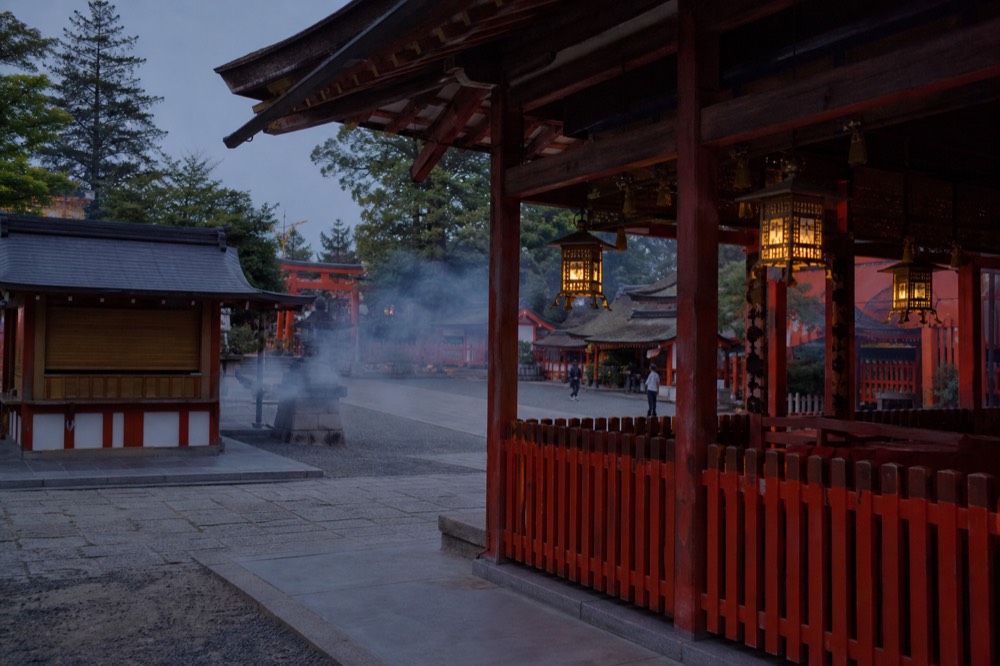
The geography works in your favour. Fushimi Inari has its own JR station one stop from Kyoto Station on the Nara Line, which is the same line you would use for a self-guided Nara trip, and the walk from the station's exit to the main shrine grounds is a few minutes. The full summit round trip in the morning, a late-morning train back, and an afternoon elsewhere in Kyoto is a standard and realistic pattern. Trying to sandwich the full two-to-three-hour circuit between two other major sightseeing blocks in one day is where plans break. This is where a site like Kyoto Nara Day Tour earns its keep: it lays out the guided coach day and the self-guided pieces so you can slot the shrine into the gap that suits you.
For the guided half of the day, the tour this site covers, run by JTB Sunrise Tours and rated 4.8 from 32 reviews, exists in six options, and the differences are departure city and lunch:
| Option | Departs | Lunch | Published price |
|---|---|---|---|
| Kyoto, no lunch | Kyoto, 08:20 meet | none | $191.65 per adult |
| Kyoto, Western set lunch | Kyoto | Western set | HK$1,597 |
| Kyoto, Indian thali lunch | Kyoto | Indian Thali | HK$1,597 |
| Osaka, no lunch | Osaka, 07:15 meet | none | HK$1,597 |
| Osaka, Western set lunch | Osaka | Western set | HK$1,698 |
| Osaka, Indian thali lunch | Osaka | Indian Thali | HK$1,698 |
Only the Kyoto no-lunch option carries a published US dollar price; the other five are published in Hong Kong dollars, and converting them is arithmetic this site will not perform. The no-lunch option is worth a hard look regardless of currency, because the included lunch is the one part of the tour its own reviewers have consistently criticised, in 2015, 2017 and again in 2025, and skipping it leaves you free to eat better and cheaper near Nara Park. If you are basing yourself in Osaka, note that the three Osaka options end at Osaka Namba and do not return to Kyoto, which pairs naturally with a morning at the shrine only if your plans end in Osaka that evening. More on that trade-off in our comparison of starting in Kyoto versus Osaka.
Whichever option you take, the pairing logic holds: the coach tour handles the six headline stops, with a licensed English-speaking guide, the coach, and admissions covered, while Fushimi Inari remains your own early-morning or evening project, free to enter and open to walkers whenever you arrive. That is the cleanest way to see both without rushing either. And if you want the full self-guided alternative instead, the train-and-walk breakdown for the other half of the trip is in our guide to a Kyoto one day itinerary.
For travellers who want the structure of a guided day, the three most popular configurations of the tour are below. Each covers the same six stops; the difference is where you start and whether lunch is included.
The questions below are the ones visitors actually ask before lacing up for the climb: how long the round trip takes, whether the shrine costs anything or closes at night, how many gates stand on the mountain, and how the walk relates to the guided coach day this site covers. The figures here match the official shrine and temple sources, so the numbers you read are the ones you can rely on when planning the climb.
Common questions about walking up Fushimi Inari
How long does it take to walk up Fushimi Inari?
About two to three hours for the full round trip to the summit of Mount Inari at a steady pace. The famous torii tunnel near the base takes a small fraction of that, so visitors short on time can see the classic gates and turn back well before the summit.
Is Fushimi Inari free to enter?
Yes. The shrine publishes no admission charge, and entry to the grounds and the mountain paths is free. The only costs are optional: amulets, goshuin stamps, offerings, and anything you buy from stalls on the mountain.
Does Fushimi Inari close at night?
The shrine publishes only desk hours for prayers, amulets and goshuin, not opening hours for the precinct. The paths are walkable at any hour, though the mountain is unlit, steep in places, and much colder after dark, so a night climb is a decision, not a default.
How many torii gates are there?
The shrine's own FAQ says about 10,000 torii of all sizes stand along the mountain paths. That figure covers the whole mountain, not just the Senbon Torii tunnel, and it is explicitly approximate; no exact official count exists.
Can you see Fushimi Inari on the Kyoto and Nara day tour?
No. The tour visits Nijo Castle, Kinkaku-ji, the Kyoto Imperial Palace, Kasuga Taisha, and Todai-ji with Nara Park, on some options with lunch. Fushimi Inari is on the opposite side of Kyoto and must be visited independently, which is easy given the shrine's own JR station.
Is the walk suitable for children or older visitors?
The lower grounds and the main torii tunnel are gentle and manageable for most visitors. The full summit circuit is a sustained climb on stone steps, roughly two to three hours round trip, so families and older walkers commonly do the lower section and turn back, which still covers the most famous scenery.