One Day in Kyoto: An Itinerary Built on the Three Big Sights
Three sites carry a Kyoto day: Nijo Castle, Kinkaku-ji and the Kyoto Imperial Palace. Here is what each one costs, when it opens, and how the bus legs between them fit into one honest day.
Short answer
One day in Kyoto covers Nijo Castle (800 yen), Kinkaku-ji (500 yen) and the Imperial Palace before lunch, with bus rides of roughly 40 minutes between them. A guided coach day from $191.65 does the same three stops, then continues to Nara; doing it yourself costs under 2,000 yen in admissions.
What can you realistically see in one day in Kyoto?
A single day in Kyoto realistically fits three major sights, not six, and the three that work best together before lunch are Nijo Castle, Kinkaku-ji and the Kyoto Imperial Palace, a sequence that sits on a workable west-to-centre axis, needs between 45 minutes and an hour and a half at each stop, and connects with bus legs of roughly 20 to 40 minutes. That is exactly the block of the city the JTB Sunrise Tours coach day covers in its morning, and the pairing is no accident: it is the sequence that survives contact with real traffic.
The arithmetic is unforgiving. Kyoto opens its big temples at 09:00, or 06:00 at a few, and most close at 17:00. Subtract a lunch hour and two or three bus legs, and you have roughly six hours of actual sightseeing. Anyone promising Nijo Castle, Kinkaku-ji, the Imperial Palace, Fushimi Inari, Kiyomizu-dera and Arashiyama in one day is describing a day spent almost entirely on buses, which is why the honest versions of this itinerary, guided or not, cut the list hard.
The tour this site covers, the Kyoto and Nara Day Tour operated by JTB Sunrise Tours, rated 4.8 from 32 reviews, takes this exact three-site Kyoto morning and bolts a Nara afternoon onto it: Kasuga Taisha and Todai-ji with Nara Park, six stops in total. It does not visit Fushimi Inari, Kiyomizu-dera, Arashiyama or Byodo-in, and any day built around those needs a different plan entirely. Our guide to spending a day trip from Kyoto covers those alternatives.
How much does a one day Kyoto itinerary cost?
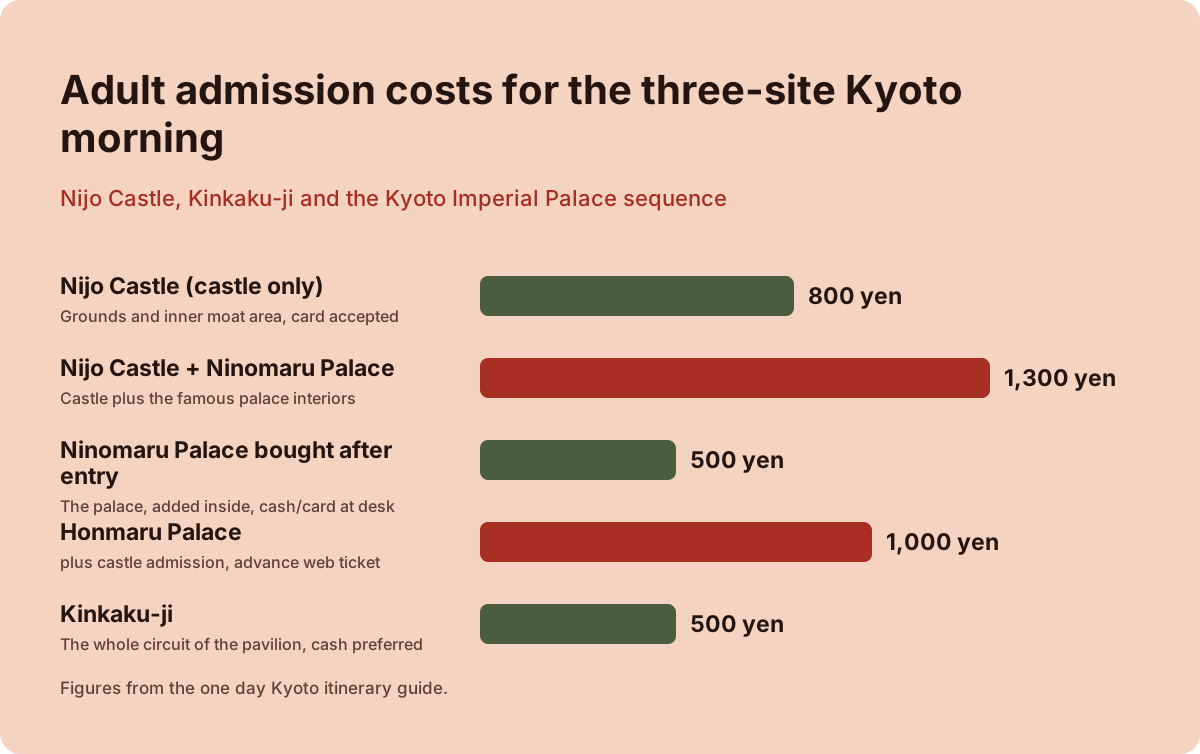
Doing the three-site Kyoto morning on your own costs under 2,000 yen per adult in admissions: 1,300 yen for Nijo Castle with the Ninomaru Palace, 500 yen for Kinkaku-ji, and nothing for the Imperial Palace park, with buses at about 230 yen a ride in the central flat-fare zone or 1,100 yen for the combined Subway and Bus day pass. The coach tour version starts at $191.65 per adult without lunch, which buys the coach, a licensed English-speaking guide, and admissions, plus the whole Nara afternoon.
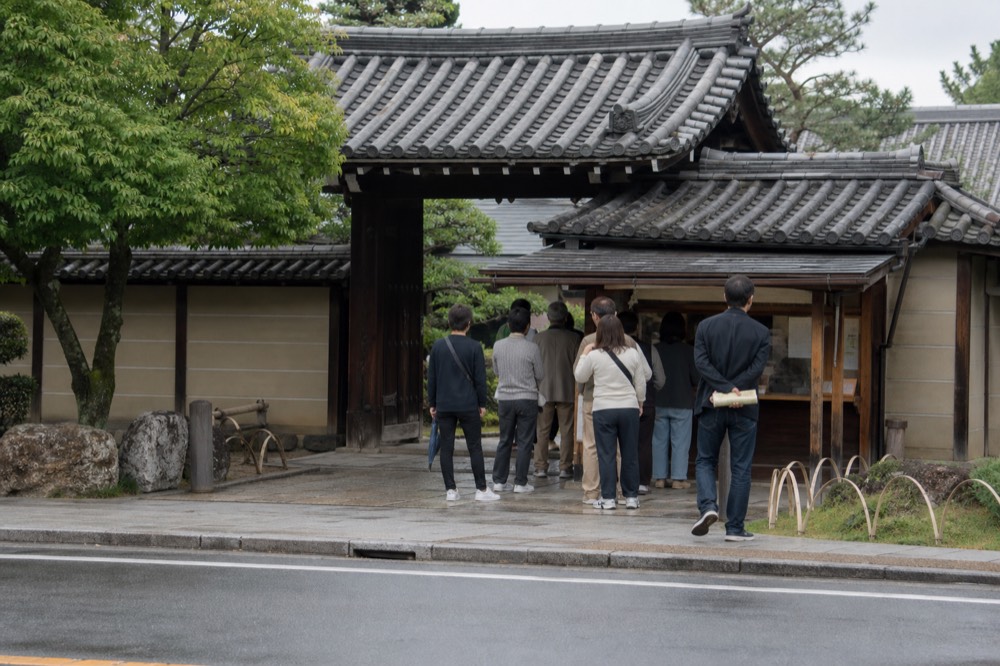
Nijo Castle is run by Kyoto City. Entry costs 800 yen, or 1,300 yen with the Ninomaru-goten Palace, so its fee page is a municipal one; Kinkaku-ji posts its fee as a scanned notice on the Shokoku-ji head-temple site.
| Sight | Adult admission | What it covers | Payment |
|---|---|---|---|
| Nijo Castle (castle only) | Admission covered by the tour | Grounds and inner moat area | Card accepted |
| Nijo Castle + Ninomaru Palace | 1,300 yen | Castle plus the famous palace interiors | Card accepted |
| Ninomaru Palace bought after entry | 500 yen | The palace, added inside | Cash/card at desk |
| Honmaru Palace | 1,000 yen plus castle admission | Advance web ticket required, released 30 days ahead | Online booking |
| Kinkaku-ji | 500 yen, adults and high school students | The whole circuit of the pavilion | Cash preferred |
| Kyoto Imperial Palace park | Free | The park; palace access runs via the Imperial Household Agency | - |
Two warnings that matter. First, the Nijo Honmaru Palace now requires an advance web ticket released 30 days ahead, even for visitors otherwise exempt from the castle fee, and it sells out; a walk-up visit gets you the castle and the Ninomaru Palace, which is the part most people come for anyway. Second, cash: Nara's temples are strict about it, and it pays to assume some Kyoto windows are too. Withdraw from a 7-Eleven or Japan Post ATM the night before, since those accept foreign cards.
If you would rather have the whole day driven, guided and ticketed in one purchase, these are the current options on the live listing.
The price spread between those options is mostly lunch and starting city. The no-lunch Kyoto departure is the one with a published dollar price, $191.65, and it is also the honest pick for food: reviewers going back a decade, in 2015, 2017 and again in 2025, have consistently rated the included set lunch as the weakest part of the day. Nara has better food within five minutes of the deer park, which is covered in detail in what to eat in Nara.
Nijo Castle first: why the morning order matters
Start at Nijo Castle at 08:45 for a 09:00 opening, because it is the only one of the three sites with interiors you actually walk through, the Ninomaru Palace corridor floors take the longest to see properly, and the crowds that build through the morning move through those interiors in one direction only. Arriving first thing means the nightingale floors, the squeaking boards built to announce intruders, are quiet enough to actually hear.
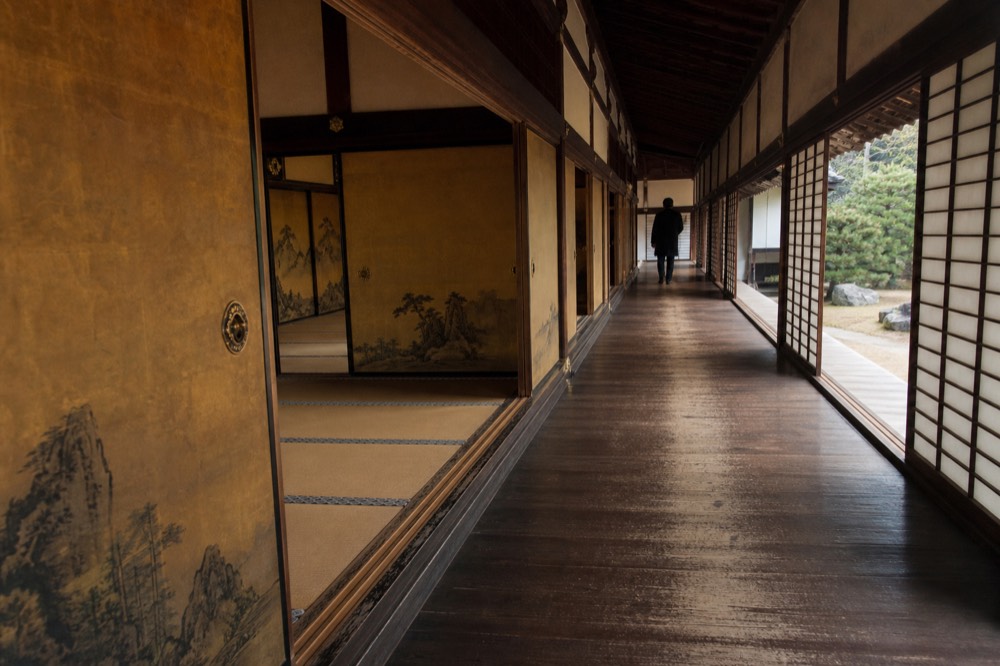
The Ninomaru Palace is the substance of the visit: five connected buildings with screen paintings, reception chambers ranked by status, and the hall where the last shogun announced the return of power to the emperor. Photography is not allowed inside, which is why the moat and the Karamon gate do all the work in visitor albums. Budget an hour for the castle and palace together, more if you want the gardens at the back.
One practical note for tour takers: this is the stop where guided groups move fastest, because the palace is a one-way route and the coach waits on a schedule. Independent visitors can slow down, which is the single biggest quality-of-life advantage of doing this morning alone. The full fee schedule, including the group rates and the Honmaru booking rule, is on Kyoto City's official Nijo Castle fee page.
Kinkaku-ji in the late morning: 45 minutes, no more
Kinkaku-ji needs 45 minutes and no more, because it is a single one-way circuit around the Mirror Pond with no interiors to enter; the pavilion itself is viewed from set angles and the exit feeds straight into the gift shop. Admission is 500 yen for adults and high school students, 300 yen for elementary and junior high, free below school age, and hours are 09:00 to 17:00 every day.
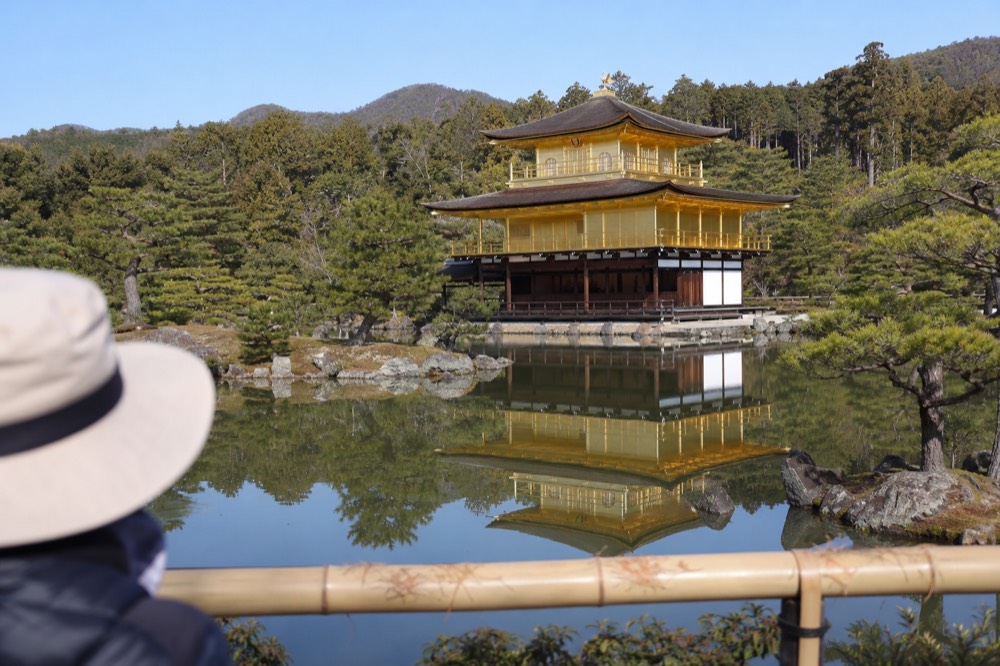
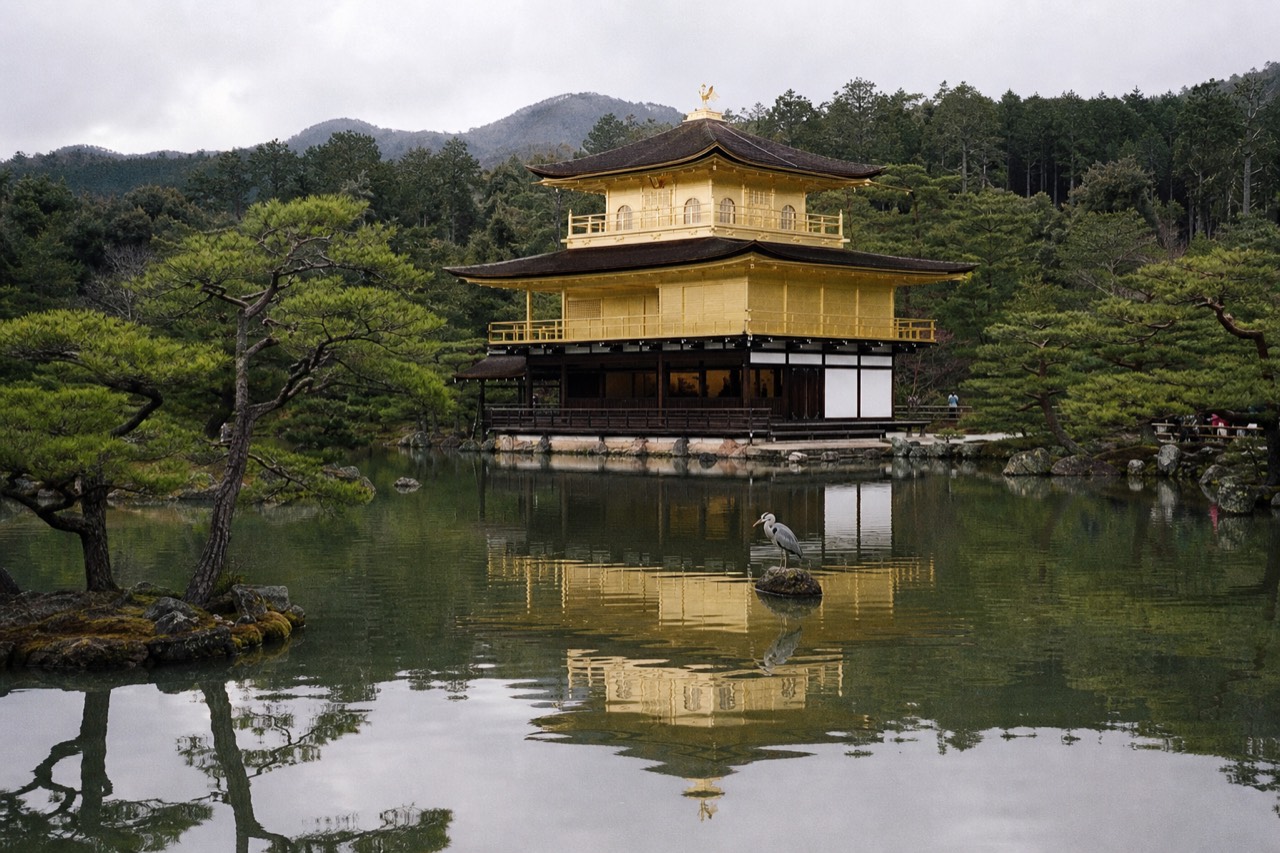
The pavilion, formally Rokuon-ji, is a three-storey structure sheathed in gold leaf over its upper floors, reflected in the roughly 6,600 square metre Kyoko-chi pond. The gardens as a whole, about 132,000 square metres, are a designated Special Historic Site and Special Place of Scenic Beauty. Most of Kiyomizu-dera's present buildings date from 1633; Kinkaku-ji's pavilion is a 1955 rebuild after a 1950 arson, recoated in gold leaf in 1987, history that is widely reported though not printed on the temple's own pages.
The crowd pattern is the real planning issue. The viewing points are narrow, tour groups arrive in waves from about 10:30, and there is no space to wait them out: the path is one-way. Going at opening, or after 15:30, is the difference between a photograph and a photograph of other people's phones. The temple's current fee notice is readable at the Shokoku-ji Kinkaku-ji news page.
For a sense of what the full guided day costs against the pieces, this is the comparison that matters.
The Kyoto Imperial Palace and lunch: the hinge of the day
The Kyoto Imperial Palace park is free, always open as a public park, and makes the best lunch hinge of this itinerary, with the palace itself accessed through the Imperial Household Agency's arrangements rather than a ticket window, which is why the park, not the buildings, should be the guaranteed part of your stop. The park's gravel avenues and trees are a calm counterweight to Kinkaku-ji's crowds, and it sits within a short bus ride of the city's lunch streets.
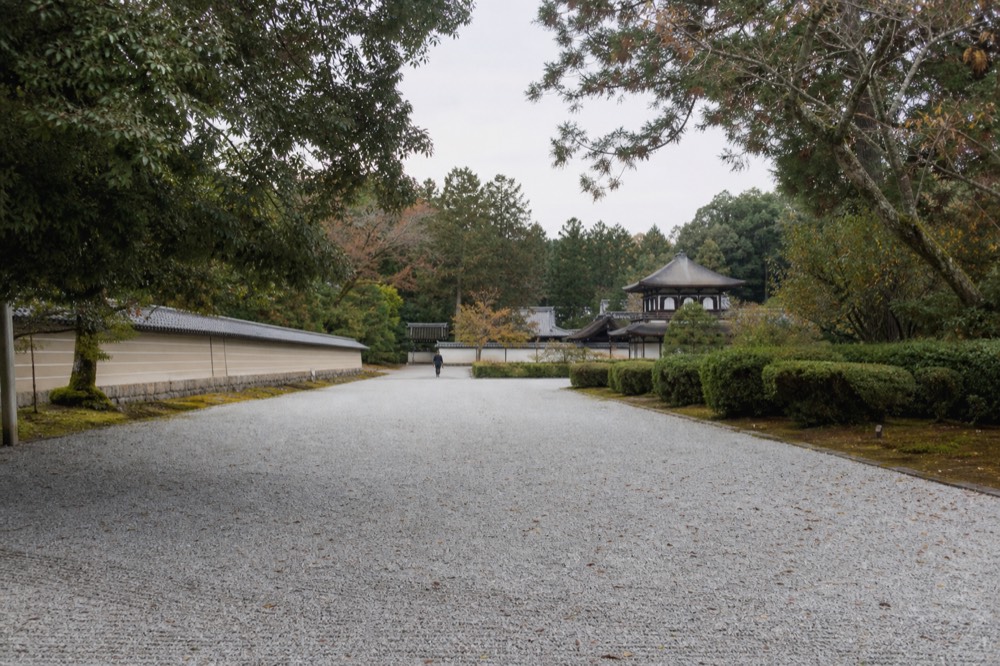
The palace was the imperial residence until the capital moved to Tokyo, and the surrounding Kyoto Gyoen park was cleared of nobles' residences to create a firebreak, which is why the space feels so open. Palace interior access is not a walk-up ticket in the way Nijo Castle is: the Imperial Household Agency administers the buildings, and visitors should treat the park as the guaranteed part of the stop and the interiors as a bonus that depends on current arrangements. There is no admission figure to state, and none is needed; the park alone justifies 30 minutes.
The coach tour uses this slot for its included lunch on the lunch options, with a Western set or an Indian thali. The honest read, repeated by the tour's own reviewers across a decade, is that the lunch is the day's weakest element, and the no-lunch option at $191.65 is the better buy for anyone who wants to eat well in Nara instead. The Kintetsu Nara Station area, five to eight minutes from the deer park, is dense with cafes and kakinoha sushi shops; our Nara food guide maps them.
How do you get between the three sites?
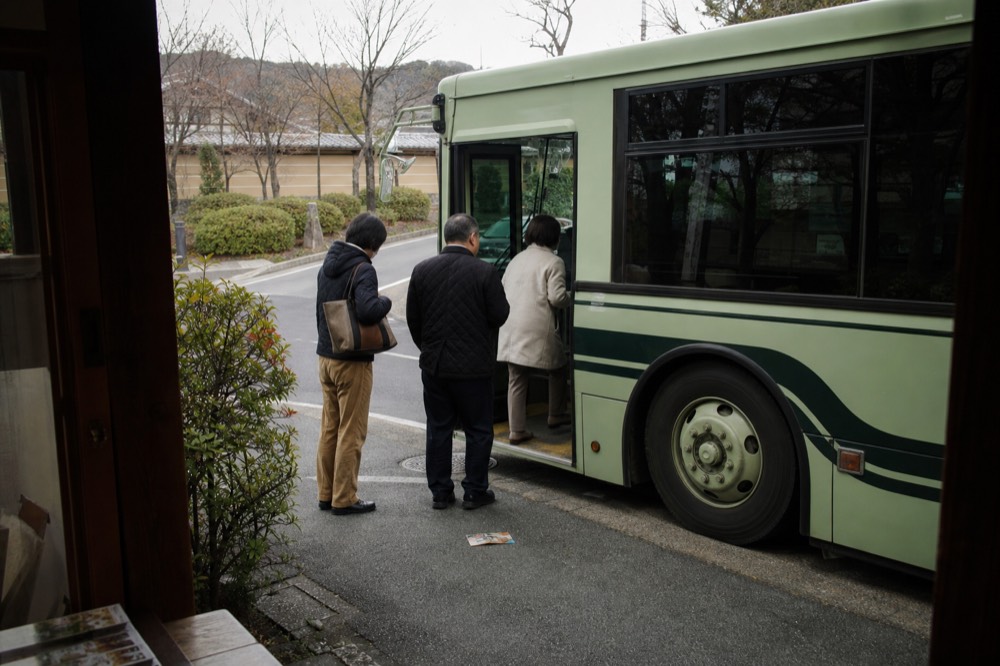
The realistic bus budget is two to three legs of roughly 20 to 40 minutes each, using city buses at about 230 yen a ride in the central flat-fare zone, or the subway for the Nijo legs, where a day's riding on the combined Subway and Bus pass costs 1,100 yen, which beats single tickets only once you ride three or more paid legs. None of the three sites has a train station at its door, so buses do the work, and the flat fare keeps the arithmetic simple.
| Leg | Rough time | Notes |
|---|---|---|
| Kyoto Station to Nijo Castle | 15-20 min | Subway Karasuma then Tozai line is faster than the bus |
| Nijo Castle to Kinkaku-ji | 35-45 min | Direct city buses, or Tozai line to Nijo then bus |
| Kinkaku-ji to Imperial Palace park | 30-40 min | City buses toward Kinugasako-mae |
| Kyoto Station coach departure | 08:20 meet | Tour pickup point per the listing |
Three cautions from the live transport picture. The old bus-only one-day pass is gone; the survivor is the Subway and Bus One-Day Pass at 1,100 yen for adults. Kyoto City Buses restrict large luggage, and drivers may refuse it, so bags belong in a coin locker or a hotel hold. And city buses take IC cards like ICOCA and Suica, but credit-card tap payment is not standard on board, so the card in your hand needs to be the IC kind.
This is also where the coach tour earns its keep. The Kyoto to Nara road leg runs about 60 to 80 minutes each way depending on traffic, and a full guided day runs about 10.5 hours from Kyoto, 11h15 from Osaka. The three Osaka departure options end at Osaka Namba and do not return to Kyoto, a detail worth checking before booking, and the Osaka pickup adds roughly 30 to 60 minutes each way. Travellers weighing the two starting cities should read Nara from Kyoto or from Osaka, which runs the comparison in full.
Can you do this Kyoto morning on your own instead of a tour?
Yes, the Kyoto half of this day is entirely doable independently for under 2,000 yen in admissions plus bus fares, and for many travellers it is the better morning; the tour's real value is the Nara afternoon, which involves a 60 to 80 minute transfer and parking logistics that are genuinely easier by coach. A confident navigator with a Suica card can replicate the three Kyoto stops exactly. What cannot be replicated alone in one day is the whole Kyoto-plus-Nara arc, because the rail transfer, the walk from the station and the deer park's time cost push the day past closing hours at one end or the other.
The decision framework is simple. If your day ends in Kyoto and you have one day for the city, do the three sites yourself in the order above and spend the afternoon anywhere the coach does not go, Fushimi Inari's torii tunnels, which the shrine says number about 10,000 of all sizes along the whole mountain, or the Arashiyama bamboo grove. If your one day is your only day for both cities, the coach tour is the only structure that fits, and our take on whether you can see Kyoto and Nara in one day goes through the timing honestly.
For travellers already staying in Osaka, the Osaka departure with the standard lunch is the option designed around that base.
When is the best time of year for this one day itinerary?
Late March to mid-April is the statistically best window: Kyoto's cherry trees flowered on 23 March and hit full bloom on 30 March in 2026, against a 1991-2020 normal of 26 March flowering and 4 April full bloom, and the park at the Imperial Palace is one of the city's best free blossom spots. The second-best window is early December, not mid-November, because Kyoto's official maple colouring date is normally 5 December, and it was 10 December in 2025.
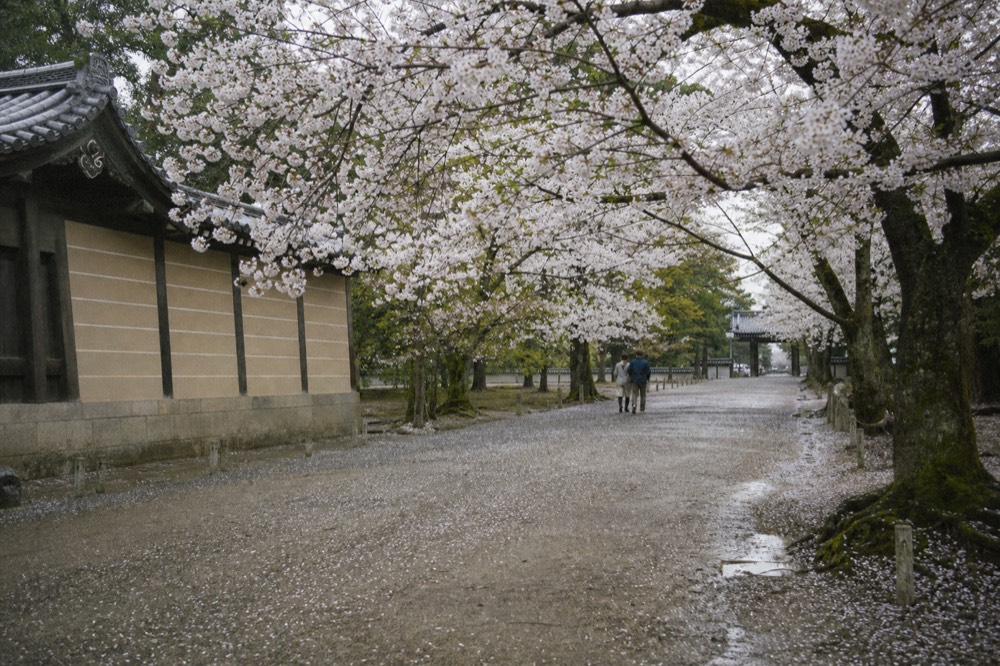
The maple fact surprises people, and it should: the mid-November autumn-colour line that fills guidebooks is folklore for Kyoto's maples. The Kyoto Local Meteorological Observatory, which has recorded these dates for over a century, puts normal ginkgo colouring at 24 November and maple colouring at 5 December, with maple leaf-fall at 18 December. Anyone booking a November trip for red maples at Kinkaku-ji is mostly a week or three early; gold ginkgo is the reliable November colour. The full phenology record, including the 2021 decision to cut the observation programme to 6 plant species and 9 phenomena, is at the Kyoto Local Meteorological Observatory's phenology page.
| Month | Mean temp C | Mean daily max C | Rain mm | Verdict for the itinerary |
|---|---|---|---|---|
| March | 8.8 | 14.1 | 106.2 | Blossom season, changeable |
| April | 14.4 | 20.1 | 117.0 | Best overall month |
| May | 19.5 | 25.1 | 151.4 | Pleasant, greener than pink |
| July | 27.3 | 32.0 | 223.6 | Hot, humid, wettest month |
| August | 28.5 | 33.7 | 153.8 | Heat records territory |
| November | 12.5 | 17.3 | 73.9 | Ginkgo gold, mild |
| December | 7.2 | 11.6 | 57.3 | Maple colour, cold mornings |
Summer deserves its own warning. Four of Kyoto's six hottest days since records began in 1880 fall in the last decade, including 39.7 C on 23 July 2026, and the mean daily August maximum is 33.7 C. A bus-and-temple day in August is survivable, but it needs the early start, water, and acceptance that the middle hours belong to shade. Spring and December crowds both peak around the foliage and blossom dates above, and the rainy season, roughly early June to mid-July in Kinki, adds a wet-driest-month calculus you can read in the best time to visit Nara.
What does the honest alternative look like?
The honest alternative for a day and no tour is the same three sites, self-driven, ending by 15:00, with the afternoon given to one thing only: Fushimi Inari if you have legs, Kiyomizu-dera and the Higashiyama lanes if you do not. The failure mode of the independent day is trying to be a coach. A coach absorbs transit time with narration and someone else's route-finding; a solo traveller absorbs it with stress. One afternoon site, chosen honestly, beats two sites reached at a run.
The cost comparison makes the trade-off plain. Independent, the day runs under 2,000 yen in admissions, about 700 to 1,100 yen in transit, and lunch wherever you like. Guided, from $191.65, the day runs itself, includes a licensed English-speaking guide, the coach and admissions, and adds Kasuga Taisha, Todai-ji and Nara Park in the afternoon. Six stops, one ticket, zero route-finding, at the price of a set lunch most reviewers shrug at and a schedule you do not control. For travellers who value the Nara half, that is a fair trade, and Kyoto Nara Day Tour exists as a site because for many people it is.
If that trade reads well against your own day, here again are the three options that matter.
The Kyoto no-lunch departure at $191.65, the lunch-included Kyoto departure and the Osaka departure with standard lunch are all the same underlying day, JTB Sunrise Tours' Kyoto and Nara circuit, priced and fed differently. The self-guided reader has the itinerary above, the numbers, the bus legs and the dates. Either way, three sites before lunch is what one Kyoto day actually holds.
A one day Kyoto itinerary works when it is cut to three sites before lunch, budgeted at under 2,000 yen in admissions, and scheduled around 09:00 openings and 17:00 closings; the questions below cover the costs, the seasons and the tour-versus-solo trade in one place.
Common questions about a one day Kyoto itinerary
What can you realistically see in one day in Kyoto?
Three major sights. Nijo Castle, Kinkaku-ji and the Kyoto Imperial Palace fit a morning-to-early-afternoon block with bus legs of 20 to 40 minutes between them; adding Fushimi Inari or Arashiyama means dropping something else.
How much does a one day Kyoto itinerary cost?
Under 2,000 yen per adult in admissions: 1,300 yen for Nijo Castle with the Ninomaru Palace, 500 yen for Kinkaku-ji, and free access to the Imperial Palace park. Buses add about 230 yen a ride, or 1,100 yen for the combined Subway and Bus day pass.
Is the coach tour or the DIY day better for one day in Kyoto?
For Kyoto alone, DIY is better and much cheaper. The coach tour's value is the combined Kyoto-plus-Nara day, which is hard to self-drive because the road transfer runs 60 to 80 minutes each way and the full day spans roughly about 10.5 hours from Kyoto.
When is the best month for this itinerary?
Late March to mid-April for cherry blossom: Kyoto's 2026 full bloom was 30 March, against a normal of 4 April. For autumn colour, early December beats mid-November, because Kyoto's normal maple colouring date is 5 December.
Does the tour include lunch, and is it worth it?
The lunch options include a Western set or an Indian thali; the no-lunch option starts at $191.65. The tour's own reviewers, in 2015, 2017 and 2025, have consistently rated the included lunch as the weakest element of the day, so the no-lunch option is the better buy for most travellers.
Is the Kyoto Imperial Palace free?
The Kyoto Gyoen park around it is free and always open. The palace buildings are administered by the Imperial Household Agency rather than a normal ticket window, so treat the park as the guaranteed part of the stop.