What food is Nara famous for?
Kakinoha sushi, Narazuke pickles, Miwa somen and fresh mochi: the foods Nara is famous for, where to eat them, and how they fit into a day trip from Kyoto.
What food is Nara famous for?
Nara is famous for kakinoha sushi, fish pressed in a persimmon leaf; Narazuke, vegetables pickled for years in sake lees; Miwa somen, hand-stretched thin noodles; and mochi pounded fresh in shopfronts, along with a tea tradition older than Kyoto's. The shika senbei sold around Nara Park, about 200 yen a bundle, is deer food, and eating it yourself is missing the point.
That list is short for a reason. Nara was Japan's capital before Kyoto, and its food culture grew out of monastery kitchens, preserved foods and court cuisine rather than restaurant districts. The city is not a place of long food streets the way Osaka's Dotonbori is. What it does have is a handful of foods with genuine provenance, most of them invented here or perfected here, and most of them available within a fifteen-minute walk of Nara Park.
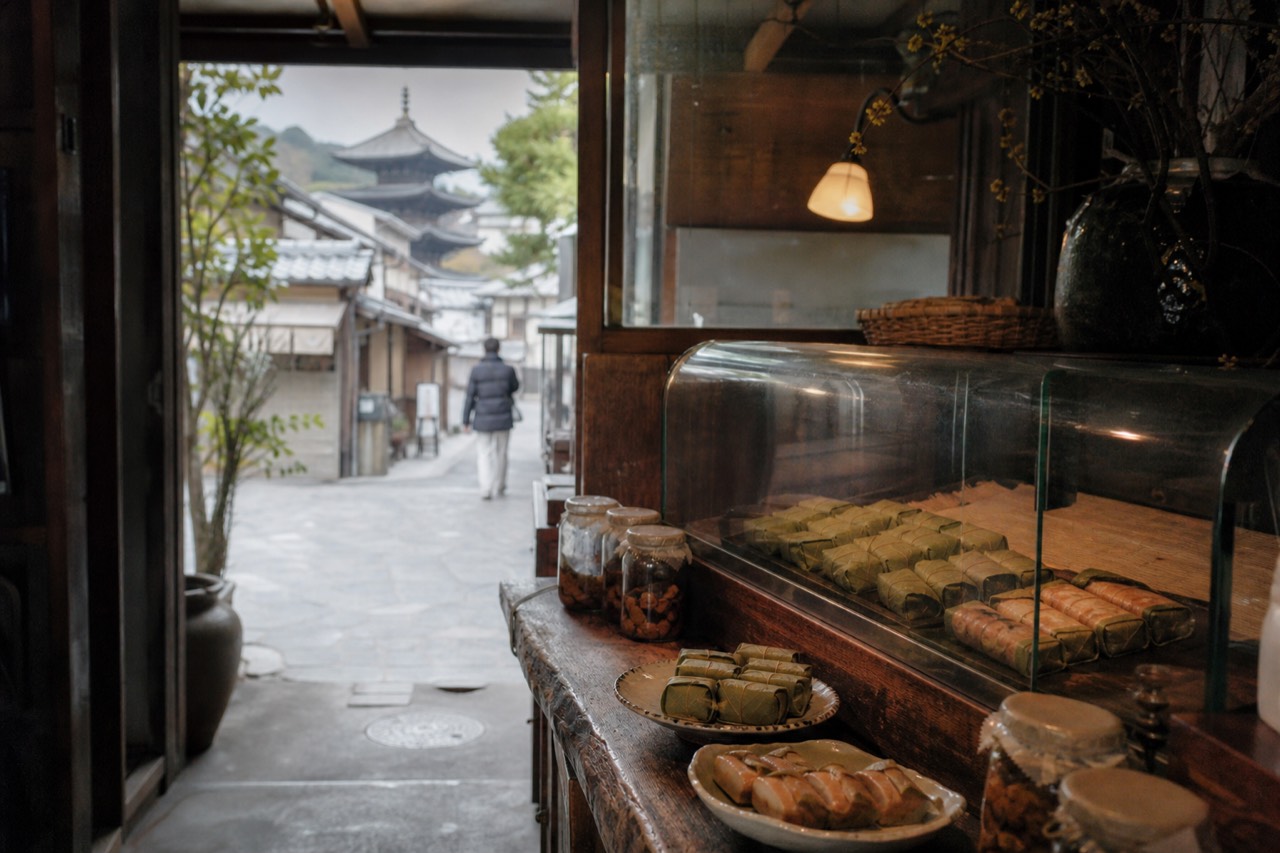
The persimmon-leaf sushi is the one to hunt down first. Kakinoha sushi is a Nara specialty born of preservation: before refrigeration, lightly salted mackerel or salmon was pressed onto rice and wrapped in a kaki leaf, whose tannins slowed spoilage on the journey from the coast to the landlocked old capital. You eat the parcel leaf and all, unwrapping it like a small gift, and the leaf's faint fragrance is considered part of the flavour. Shops around Nara Station and in Naramachi sell it in neat boxes, and it travels well, which is why it has long been a gift food rather than a restaurant dish.
Narazuke is the second pillar. This is deep pickling: shirouri melon, uri gourd, ginger and sometimes daikon cured in sake lees, in some cases for years, until the flesh turns amber-brown and dense with umami. It began as temple food, associated with the Buddhist kitchens of Nara's great institutions, and it remains an acquired taste worth acquiring, salty and complex, eaten in thin slices with rice. Any decent pickle shop in Naramachi will let you buy a single slice to try.
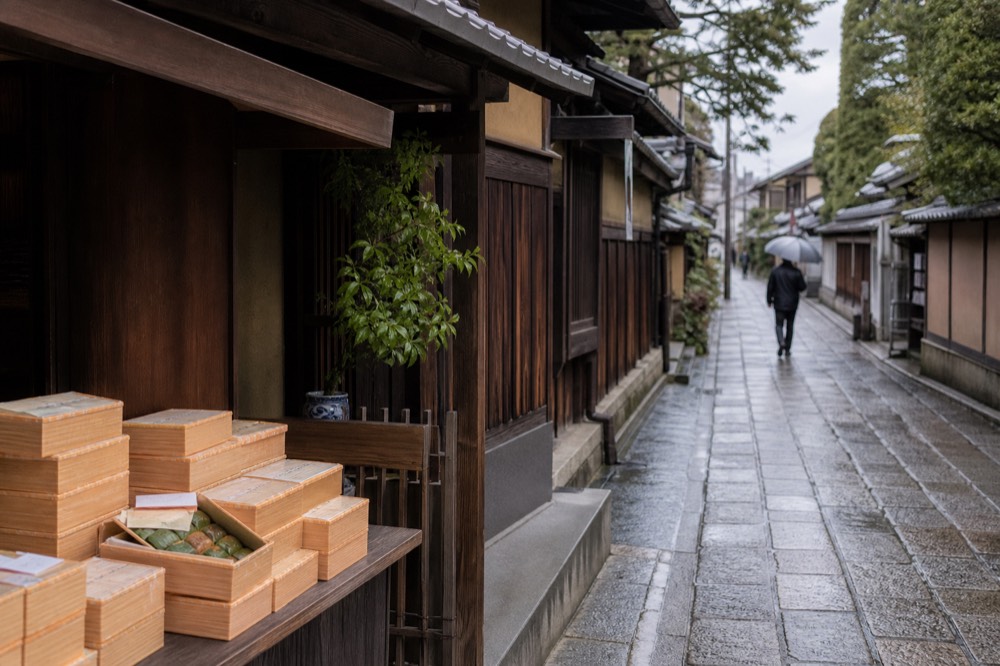
Third, Miwa somen. The village of Miwa, on the eastern edge of the Nara basin at the foot of Mount Miwa, is one of the homes of hand-stretched noodles in Japan, and its somen, thin wheat noodles pulled and oiled by hand over days, is served cold with a dipping broth. The conventional account credits Miwa's shrine kitchens with the technique, and the noodles still carry the mountain's name. In central Nara you will find restaurants built around Miwa somen, often in a cold style with seasonal toppings.
Fourth, mochi, and specifically the theatre of it. Nara's most famous mochi shop pounds rice in its front window at speed, two wooden mallets and a flipping hand, and the performance draws a crowd on Naramachi's main street. The mochi itself is plain, dusted in toasted soybean flour and cut while still warm, and it is best eaten within a minute of buying. There is no clever variation to chase; the whole appeal is freshness.
| Food | What it is | Where to find it |
|---|---|---|
| Kakinoha sushi | Pressed sushi of mackerel or salmon wrapped in a persimmon leaf, a preservation method from the pre-refrigeration capital era | Boxed at shops near Nara and Kintetsu Nara stations and in Naramachi |
| Narazuke | Vegetables such as shirouri melon and ginger deeply pickled in sake lees, sometimes for years, a temple-kitchen tradition | Pickle shops in Naramachi, sold by the slice or the jar |
| Miwa somen | Thin hand-stretched wheat noodles from the Miwa area, served cold with dipping broth | Somen restaurants in central Nara |
| Fresh mochi | Rice pounded with wooden mallets in the shop window, cut and served warm within moments | The famous mochi counter on Naramachi's main street |
| Yamato tea | Locally grown green tea from the Nara highlands, part of one of Japan's oldest tea-growing regions | Teahouses and cafes around Nara Park and Naramachi |
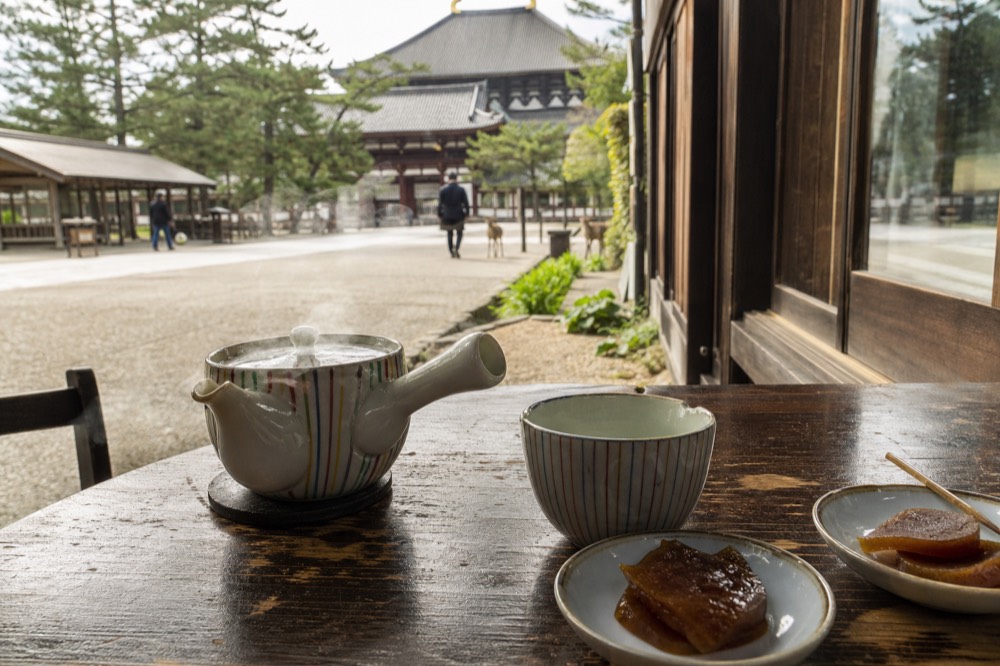
Tea deserves a line of its own. Nara's highlands grow Yamato cha, and the region is widely credited as the birthplace of cultivated tea in Japan, with the tradition said to begin at a temple garden rather than a farm. The claim is ancient and contested, as ancient claims are, but the tea is not: order a pot in a Naramachi cafe and you get a deep, rounded green tea with more astringency than sweetness, quite different from Uji's softer style. Sipping it is the closest you get to tasting the eighth century.
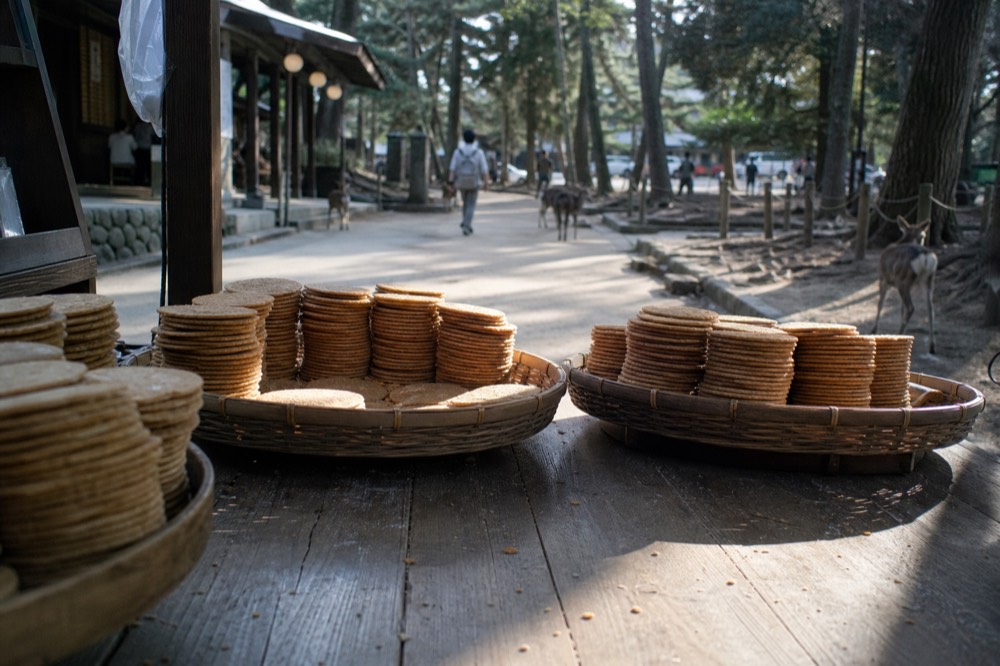
There is one more thing to say plainly, because a surprising number of visitors get it wrong. The crackers stacked at stalls around Nara Park are not a snack for you. Shika senbei, about 200 yen for roughly ten crackers, is licensed deer food sold for feeding the animals, and it is the only thing you may feed them. For a fuller rundown of the city's eating and drinking scene beyond the famous five, our guide to what to eat in Nara goes deeper into restaurants and specialities.
If your day in Nara arrives as part of a guided outing from Kyoto, these food questions start to matter for practical reasons, which is worth the next section. The site behind this article, Kyoto Nara Day Tour, exists precisely because that day of temple-hopping and eating deserves a bit of planning.
Where do Nara's food traditions come from?
Nara's food traditions come from its long stretch as Japan's capital before Kyoto, when the imperial court and the great Buddhist temples created a demand for preserved, transported and ritual food that still defines the city's kitchen: pickles that could age, sushi that could travel, noodles stretched by hand, and tea grown on temple land.
The geography explains most of it. Nara sits in a basin surrounded by mountains, far from the sea. In the centuries before refrigeration, seafood had to arrive salted or cured, and the persimmon-leaf wrap was one answer; the deep sake-lees pickle was another, converting the byproduct of the region's breweries into a preserving medium. Both foods are, at root, logistics solved deliciously. That is also why Nara's cooking leans preserved and fermented where Osaka's leans fresh and fried: one city fed a court and a clergy, the other fed a merchant port.
The temples did more than preserve vegetables. Buddhist precepts discouraged meat, so monastery kitchens in Nara developed vegetable cookery, tofu work and grain dishes to a high pitch, and the food that filtered out of the temple gates into the town became the base of Nara's home cooking. Narazuke is the clearest survivor, but the same lineage runs through Nara's simple rice-and-pickle café meals and through the vegetarian shojin-style menus some Nara restaurants still offer near the temple precincts.
Mochi and somen come from a slightly different thread, the craft-food tradition. Both are labour-intensive foods where the skill is in the maker's hands: the somen master stretching and resting dough over days, the mochi crew timing mallet strikes to the second. Nara kept these crafts partly because its tourism is built on old streets and old skills, so a shop that pounds rice in its window is both a business and a performance of continuity. Eating there is participating in that, briefly and cheaply.
Understanding this background changes how you eat your day. The foods worth queuing for are the ones whose production you can see or whose recipe predates the Edo period. The foods you can skip are the generic snack stalls that follow any famous park. If you are planning the day around the animals rather than the menu, the guide to things to do in Nara maps the rest of the city, and the answer to why Nara Park is so famous covers the deer themselves.
Is the included lunch on the Kyoto and Nara day tour worth it?
On the guided day tour that links Kyoto's Nijo Castle, Kinkaku-ji and the Imperial Palace with Nara's Kasuga Taisha and Todai-ji, the included lunch is the weakest element by its own reviewers' accounts, in 2015, in 2017 and again in 2025, so travellers serious about Nara's food should take a no-lunch option and eat in the city instead.
That is an unusual thing for a tour site to say, but the pattern in the reviews is consistent enough to repeat. The lunch options on the tour are a Western set menu or an Indian thali, and reviewers across a decade have described the included meal as functional rather than memorable. Nobody crosses the world to eat a functional set menu in one of Japan's oldest food cities. The Kyoto and Nara Day Tour is rated 4.8 from 32 reviews overall and runs from $191.65 per adult on the Kyoto no-lunch option, so the core of the product is not in question; the plate is.
The economics point the same way. Only the Kyoto no-lunch option carries a published dollar price, from $191.65 per adult; the five other options, the Kyoto and Osaka departures with either lunch, are published in Hong Kong dollars on their listings. What the fare already covers is a licensed English-speaking guide, the coach between the six stops, and the admissions along the way, so skipping the lunch buys you freedom, not a cut-down tour. Three of the six stops are in Kyoto and three in Nara, and the Nara stretch, Kasuga Taisha, Todai-ji and Nara Park, is where your food money should land anyway.
| Tour option | Departs | Lunch | Published price |
|---|---|---|---|
| Kyoto, no lunch | Kyoto, 08:20 meet | None | From $191.65 |
| Kyoto, Western set | Kyoto | Western set lunch | HK$1,597 |
| Kyoto, Indian thali | Kyoto | Indian Thali | HK$1,597 |
| Osaka, no lunch | Osaka, 07:15 meet | None | HK$1,597 |
| Osaka, Western set | Osaka | Western set lunch | HK$1,698 |
| Osaka, Indian thali | Osaka | Indian Thali | HK$1,698 |
One logistics note if you do eat independently: carry cash. Todai-ji states on its own admission page that payment is cash only, as does Kofuku-ji, and plenty of Nara's small food shops still prefer notes and coins. The ATM habit of the big cities does not automatically extend to a mochi counter or a pickle stall in Naramachi, and the last stretch of a day tour leaves little time to hunt for a machine.
The three Osaka options also finish at Osaka Namba rather than returning to Kyoto, which suits travellers staying in Osaka, but it does not change the lunch logic. An evening in Osaka is a fine place to eat lavishly after a light, self-directed Nara lunch; doing it the other way round means your best meal of the day is the one the tour provided, and that, per a decade of reviews, is a mistake.
What about the shika senbei at Nara Park?
Shika senbei is food, but not for you: the crackers are the only thing visitors may feed the deer, sold at about 200 yen for roughly ten, produced under licence from the Nara Deer Preservation Foundation, with the proceeds going to deer welfare, and handing them over correctly is a small skill in itself.
The foundation's own guidance is specific and worth following to the letter. Feed the deer nothing except shika senbei, human food harms them. Hand the cracker over quickly, do not tease, and never hold it in a closed fist, because a deer that cannot see the cracker will follow you and press until it gets one. The animals are habituated but wild; they bite, butt and charge, and the foundation asks visitors to give extra space to older people and small children. The full rules are published by the Nara Deer Preservation Foundation.
Timing matters for two reasons. The 2026 census counted 1,687 deer in the park, the highest count the foundation has published in recent years, so there are more mouths at every stall than there used to be, and crackers have been known to sell out by midday at busy times. Buy a bundle early if feeding the deer is on your list. And mind the season: the foundation designates June and November as deer-protection months, calving season and the rut, when does and stags respectively turn aggressive, and September through November is the period to keep the most distance.
The bowing deer are real, to a point. Nara's sika learn to bow for crackers because bowing humans reward the behaviour with food, and a polite deer gets fed. It is charming and slightly transactional, and it is the single most photographed food transaction in the city. Just remember the direction of travel: you buy the cracker, the deer eats the cracker, and your own lunch should happen somewhere with a counter and a menu.
There is a debate around the park's herd, its size and its management, which we cover separately in the piece on the Nara deer controversy. The short version for eaters: the crackers exist because a century-old foundation wanted feeding to be safe, licensed and revenue-supporting, not because the park needed another snack stall.
Where should you eat around Nara Park and Todai-ji?
Eat in the lanes within ten minutes of the park: Naramachi's preserved machiya streets for mochi, pickles and café lunches, the Higashimuki and Sanjo arcade near Kintetsu Nara Station for kakinoha sushi and quick somen, and the small restaurants along the approach to Todai-ji for sit-down meals, carrying cash throughout because temple admissions in Nara are cash only.
Naramachi is the food walk with the most texture. The old merchant district's streets are lined with machiya shopfronts, and the food stops come thick and fast: the mochi counter with its mallets, pickle barrels of Narazuke open for sampling, kakinoha sushi boxed for the train home, and a run of cafes pouring Yamato tea into rooms that were once merchants' homes. An hour here covers a lot of the famous-food list on foot. The pace suits a tour day too, since the district sits between Kintetsu Nara Station and the park, exactly the corridor you walk anyway.
The arcade near the stations is the practical layer. Higashimuki and its continuation toward Sanjo Dori are covered shopping streets, useful in rain, fast at lunchtime, and dense with sushi boxes, somen shops and stands selling skewers and rice balls. This is where you buy kakinoha sushi to carry home; shops pack it in insulated boxes and it keeps a day or two chilled. It is also where a tour group scatters most happily, because everyone from the fussy eater to the adventurous one finds something within fifty metres.
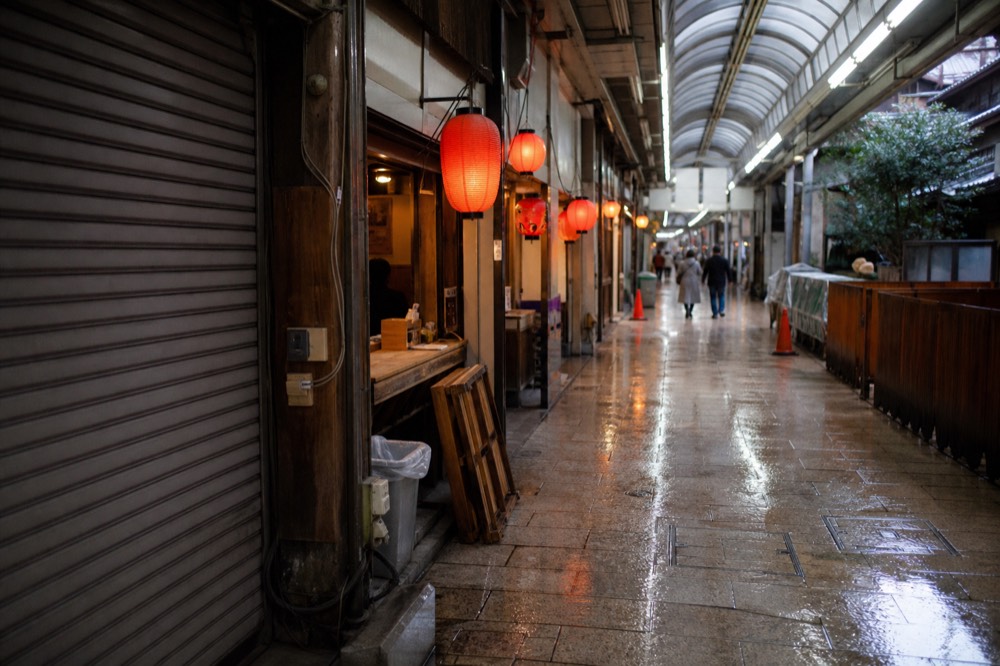
Around Todai-ji the eating thins out and rises in seriousness. The approach road and the lanes near Nara Park's east side hold a scattering of proper restaurants, some in traditional buildings, serving set meals that lean on local vegetables, Yamato beef and Miwa somen. Book or arrive early on weekends; the park pulls huge numbers, and a sit-down lunch within sight of the Daibutsuden is the one thing in Nara that genuinely runs out. The temple itself opens the Daibutsuden from 07:30 between April and October and 08:00 from November to March, with admission at 800 yen, cash only, per its own admission page, so an early temple visit followed by a late-ish lunch threads the crowds nicely.
A word on time. A coach day tour that includes Kyoto's three stops and Nara's three typically runs about 10.5 hours from Kyoto, door to door, with roughly 60 to 80 minutes of driving each way between the cities. That leaves a real but bounded window in Nara, which is the strongest argument for the no-lunch options described above: every minute spent on a set menu the reviews have never loved is a minute not spent at a mochi counter or a pickle barrel. Travellers deciding how much Nara time they need at all can start with can you see Kyoto and Nara in one day, and those weighing the two bases can compare Nara from Kyoto or from Osaka.
For anyone building an independent itinerary rather than a guided one, the food stops above cluster neatly onto the standard walking route from Kintetsu Nara Station through Naramachi to the park, Kofuku-ji, Kasuga Taisha and Todai-ji, the same geography traced in our Nara day trip from Kyoto guide. You do not need a car or a bus to eat Nara well; you need comfortable shoes and an empty stomach.
Nara's famous foods are kakinoha sushi, Narazuke pickles, Miwa somen, freshly pounded mochi and Yamato tea, with shika senbei reserved for the deer; the answers below cover where to eat each one, whether the tour's included lunch is worth skipping, and how the deer crackers actually work.
Common questions about Nara's food
What food is Nara famous for?
Kakinoha sushi pressed in persimmon leaves, Narazuke pickles cured in sake lees, Miwa somen noodles, freshly pounded mochi and Yamato tea. The shika senbei sold around Nara Park, about 200 yen a bundle, is licensed food for the deer, not a human snack.
Is Nara good for food?
Yes, but differently from Osaka or Kyoto. Nara's strengths are preserved and fermented specialities with ancient roots, craft foods like hand-stretched somen and window-pounded mochi, and a compact walkable eating district in Naramachi, rather than a big restaurant nightlife scene.
Where should I eat lunch on a day trip to Nara?
Naramachi for mochi, pickles and café meals, the Higashimuki arcade near Kintetsu Nara Station for quick sushi and somen, or a set-meal restaurant near the Todai-ji approach for a sit-down lunch. Carry cash, since temple admissions and many small shops in Nara do not take cards.
Can you eat the deer crackers at Nara Park?
You can, technically, since they are rice crackers, but you should not. They are produced as licensed deer food sold to fund deer welfare, and the foundation's rules treat them as feed. Buy human food a few streets away in Naramachi instead.
Should I book the day tour with lunch included?
Probably not, if food matters to you. The included Western set or Indian thali lunch is the weakest-reviewed element of the Kyoto and Nara day tour, in 2015, 2017 and again in 2025, while the no-lunch options cost less, from $191.65 on the Kyoto departure, and leave the lunch hour free for Nara's own food.
Does kakinoha sushi keep for the trip home?
Better than most sushi, because the persimmon leaf and the pressed preparation were designed for travel in the days before refrigeration. Shops sell it boxed, and it keeps a day or two chilled, making it one of the better edible souvenirs from the region.